Wednesday, March 9, 2011

ABRAHAM MASLOW


If you only have a hammer, you tend to see every problem as a nail


Abraham Maslow was a famous America psychologist who developed the notion of a hierarchy of human needs. Maslow is also credited as creating humanistic psychology and is well known for his published works Motivation and Personality and Toward a Psychology of Being.

Abraham Maslow was born on April 1, 1908 in Brooklyn, New York. As the first child to Russian-born Jewish immigrants, Maslow was pushed into succeeding in school since his parents had grown up with little education. Maslow studied hard and eventually enrolled in the City College of New York where he stayed for three semesters. After transfers back and forth to Cornell, Maslow finally moved out of New York and finished his B.A., M.A., and Ph.D. in psychology at the University of Wisconsin in Madison. Prior to graduating, Maslow took his first cousin, Bertha Maslow, as a wife.

After achieving his degrees, Maslow returned to New York to work at Columbia University with E.L. Thorndike. Shortly thereafter he began teaching at Brooklyn College where he met Alfred Alder and Erich Fromm, the leading European psychologists of that time. With his connections and accrued knowledge, Maslow became the chairman of the psychology department at Brandeis University in 1951. It was during this time that Maslow befriended Kurt Goldstein who gave Maslow his first look at the idea of self-actualization, an idea Maslow would later use to create a hierarchy of human needs.

"Maslow's Hierarchy of Needs" is considered a cornerstone in the study of self-actualization. According to Maslow, humans follow a distinct pattern of needs in their life. When one need is met, the next one in the hierarchy is used as motivation. These needs, listed in ascending order, are: physiological, safety, social, esteem, and self-actualization. Once a lower need is met, a higher one is sought. Needs listed lower on the hierarchy are more powerful and more basic while higher ones are thought to be unique only to humans.

Maslow fell into ill health later in life and in 1970 he died of a heart attack. He was 62 and living in California.


Tuesday, March 8, 2011

HOWARD NEMEROV


A teacher is a person who never says anything once.


The American writer Howard Nemerov (1920-1991) was recognized for his novels, short stories, criticism, nonfiction, drama, and satiric poetry, as well as for being the third poet laureate of the United States.

Howard Nemerov was born on March 1, 1920, in New York City. His parents were David and Gertrude (Russek) Nemerov. David, his father, served as president and chairman of the board of Russeks, a now defunct but once prestigious retail store, where he earned the reputation of "Merchant Prince." The elder Nemerov's talents and interests extended to art connoisseurship, painting, and philanthropy--talents and interests undoubtedly influential upon his son.

Young Howard was raised in a sophisticated New York City environment where he attended the Society for Ethical Culture's Fieldstone School. Graduated in 1937 as an outstanding student and second string team football fullback, he commenced studies at Harvard University where, in 1940, he was Bowdoin Essayist and, in 1941, earned the Bachelor of Arts degree.

Upon graduation at the age of 21 he joined a Royal Canadian unit of the U.S. Army Airforce, serving as a pilot throughout World War II. After training in both Canada and England, he flew coastal command missions over the North Sea and was discharged in 1945 at the rank of first lieutenant. Prior to discharge he married Margaret Russel, on January 26, 1944.

Returning from the war, he and his wife spent a year in New York where he finished work on his first book of poetry. Nemerov then turned to college teaching--a profession he found compatible with his writing career. He served on the faculties of Hamilton College in Clinton, New York (1946-1948); Bennington College in Bennington, Vermont (1948-1966); Brandeis University in Waltham, Massachusetts (1966-1969); and in 1969 joined the faculty of Washington University in St. Louis, Missouri. During this time Howard and Margaret parented three sons: David, Alexander, and Jeremy.

uring the years 1963 and 1964, Nemerov served as consultant in poetry to the Library of Congress, where later he held the post of poet laureate of the United States (1988-1990). Nemerov became a member of the American Academy of Arts and Letters in 1977. In 1978 he was recipient of both the Pulitzer Prize in Arts and Letters and the National Book Award for his Collected Poems.

The early promise of Nemerov's first book of verse, The Image and the Law (1947), was satisfyingly fulfilled in his later publication of poems, War Stories (1987), which provides a kindly light on the bleak landscape of contemporary American poetry. Nemerov persisted in a gentle irony which satirizes as much through self-deprecation as indictment of others, a kind of collective guilt and redemption exquisitely expressed in his 1980 poem "The Historical Judas," whose name" ... shall surely live/To make our meanness look like justice in/All histories commissioned by the winners."

Transcending mere polemic, Nemerov's poetic argument with history captivates, by virtue of his humor and humanism. Composing in narrative, meditative, lyrical, satirical, and a variety of other forms, Nemerov's poems are profoundly concerned with the individual perception of nature, and human history as a part of nature--a concern which might be intellectually ponderous were it not for the comic relief provided by his native wit. But Nemerov is a poet, not a philosopher, and his poetic wit disperses accusations of academic philosophical waxing with a whip woven of puns, slang, and irony.

Nemerov's quarrel with the world resounds with the lesson that humanity does not learn from history, but is seemingly doomed to repeat mistakes of the past. The importance of hope itself becomes ironic at the hands of the poet, as notice is made of the contradictions between the facts of history and the fictions of human aspiration. Sharing the collective guilt of the humorist, Nemerov's irony is sometimes too light an instrument for the dispatch of the sorrows of the human condition. Nemerov was perhaps a bit too accepting of man's inevitable fate; but neither is he a Pangloss (incurable optimist) nor a rager against the night.

Nemerov's poetic vision, his perceptual struggle with illusion and reality through a mysterious roseate but dark glass, never descended from poetic flight to epistemological speculation--not even on that most dangerous killing ground of political poetry. In versatile blank verse, Nemerov was at his best, conjuring the poetic experience out of a sense elusive world.


In spite of his other endeavors as editor, critic, and nonfiction writer, Nemerov was a master at throwing the magic switch between the prose and poetic modes of composition. Facile accusations of academicality, intellectuality, and ideationality against his poetry pale in confrontation with the poetic imagery of his 1967 poem "The May Dancing." Another 1967 poem, "Learning by Doing," mildly reminiscent of Frost's "Birches," is fraught with imagery, as is his 1989 publication "Landscape With Self Portrait."

If, in both his earlier and later works, his historical imagery is mistaken for history per se, the fault is not his. Nemerov pointed out clearly that: "The reason we do not learn from history is/Because we are not the people who learned the last time." Knowledge is not inherited, but must be earned by each new generation. Today's history lesson derives from yesterday's characters; events and ideas become image and metaphor in poetic time; time mellows metaphor into symbol and myth.


All too lazy an age has wrongfully castigated Nemerov for his technical knowledge of poetry, his use of form, and his foundation in tradition. In essence, his versification virtues are mistakenly deemed vices; his own historical poetic derivation is unrecognized by those ignorant of that poetic history; his artistic order is minimized as mere orderliness by the disorderly--and still, a well turned scherzo refreshes, and craft and art are still the best of friends.


On July 5, 1991, Howard Nemerov died of cancer at his home in University City, Missouri.


Saturday, March 5, 2011

COLIN POWELL


A dream doesn't become reality through magic; it takes sweat, determination and hard work

During Colin Powell's long and impressive military and government career, he has served in some of the country's highest positions, including chairman of the Joint Chiefs of Staff. When President George W. Bush (1946–) chose Powell for the job of secretary of state, he became the first African American to ever serve in this position.
Colin Luther Powell was born in the Harlem neighborhood of New York, New York, on April 5, 1937. His parents were immigrants from Jamaica. He spent most of his childhood in the South Bronx neighborhood of New York City, which was then regarded as a step up from Harlem. The neighborhood included white, African American, and Puerto Rican residents. Powell has said that he never thought of himself as a "minority" while a child.
Despite his parents' urgings that he should "strive for a good education" in order to "make something" of his life, Powell remained an ordinary student throughout high school. At City College of New York, however, Powell discovered his leadership skills after joining the army's Reserve Officers' Training Corps (ROTC). He graduated from the program in 1958 and was made a second lieutenant (an army officer who is below all other officers) in the U.S. Army. He was then assigned to duty in West Germany. In 1962 he met and married Alma Vivian Johnson, with whom he eventually had three children.
Powell's next overseas assignment was in South Vietnam. At the time the United States was involved in the Vietnam War (1955–75; a civil war in which anti-Communist forces in South Vietnam, supported by the United States, were fighting against a takeover by Communist forces in North Vietnam). During his first tour of duty in Vietnam (1962–63), Powell was wounded in action. He returned for a second tour (1968–69) and received the Soldier's Medal for pulling several men from a burning helicopter.
After his second tour in Vietnam, Powell returned to the United States and studied for a master's degree in business administration at George Washington University in Washington, D.C. He received the degree in 1971, then went to work at the Pentagon, the headquarters of the U.S. Department of Defense and military services. He then moved on to a position in the Office of Management and Budget under the director, Caspar Weinberger (1917–), and his deputy, Frank Carlucci (1930–). These two men were to have a major influence on Powell's career.
In the late 1970s, Powell attained the rank of major general (an army officer who is above a brigadier general) and held positions in the Pentagon and Department of Energy. In 1983 he became a military assistant to Weinberger, who was then the secretary of defense under President Ronald Reagan (1911–). While Powell was assisting Weinberger, his advice was sought by the National Security Council (NSC), the agency within the executive branch that advises the president on affairs relating to national security. The NSC wanted to make a secret sale of weapons to Iran in the belief that it would help to free American hostages that were being held in Lebanon by terrorist groups supporting Iran. Powell advised the NSC that the sale was illegal. His opposition helped to establish a reputation for having strong moral character that later served him well and that kept him from being harmed when the NSC's illegal arms deal was eventually exposed.
In 1986 Powell was asked by President Reagan to become Frank Carlucci's deputy on the NSC. He replaced Carlucci as national security adviser (head of the NSC) in 1987 and held the post for the rest of the Reagan administration. Arms control and attempts to overthrow the socialist government of Nicaragua were high priorities for Powell and other policy-makers during this period.
When President-elect George Bush (1924–) told Powell that he wished to name a new national security adviser, Powell could have chosen to leave the army to earn a substantial income giving lectures or consulting in the business world. However, Powell did not retire. Instead, having been promoted to full general (an army officer who is above a lieutenant general), he took over the army's Forces Command. In this position he was responsible for overseeing the readiness of over a million regular, reserve, and National Guard personnel in the United States. Powell took on more responsibility when he was nominated by President Bush in 1989 to become chairman of the Joint Chiefs of Staff (JCS; the group that is responsible for giving military information and advice to the president, the secretary of defense, and the National Security Council). Powell was the first black officer to hold this post.
As chairman of the JCS, Powell played a key role in the December 1989 American military invasion of Panama to unseat that country's military leader, Manuel Noriega (1938–). Earlier in 1989, Noriega, who had been in control of the Panamanian government since 1983, had cancelled presidential elections. Noriega was also involved in the buying and selling of illegal drugs and other unlawful activities. The U.S. government overthrew Noriega in an effort to bring the leader to the United States to be tried on drug charges, to protect Americans, and to give the Panamanian people back their freedom. Television appearances in which Powell explained the purpose of the operation brought him to the favorable attention of the American public.
Powell was also highly visible during Operation Desert Shield. This was a joint effort by the United States and several other nations to pressure Saddam Hussein (1937–), the president of the Middle Eastern nation Iraq, into removing his forces from the neighboring country of Kuwait. Iraq had occupied Kuwait in August 1990. It soon became apparent that this operation, unlike the one in Panama, would take months to decide and involved the risk of high casualties (deaths of soldiers) if war broke out between the Iraqis and the international forces.
Operation Desert Shield turned into Operation Desert Storm on January 16, 1991, beginning the six-week conflict that was known as the Persian Gulf War. Powell again demonstrated his leadership during this time, and the Iraqi army was swiftly crushed. For his part in this war, Powell was awarded a Congressional gold medal.
After Powell retired from the military in 1993, he was often mentioned as a potential candidate for president. While many hoped that he would run for president in 1996, he announced in 1995 that he would not do so. Instead, Powell supported George W. Bush in the campaign that led to Bush's election in 2000. On December 16, 2000, Bush announced that he would name Powell as his secretary of state, the nation's top foreign policy position. Powell was the first African American named to this post.
On September 11, 2001, anti-American terrorists crashed jet planes into the Pentagon and into the two towers of the World Trade Center in New York City. The attack killed thousands and led Bush to declare that the United States would pursue a "war on terrorism." The Bush administration's efforts concentrated initially on targets in Afghanistan, and Powell's greatest challenge was to build support for the American "war" among Arab and Muslim governments. As the effort to stamp out terrorism continued, Powell was perceived as a force for moderation in the Bush government, pushing for the building of alliances and for restraint when others argued for more aggressive military action.


Friday, March 4, 2011

WILLIAM SAMUEL JOHNSON


Curiosity is, in great and generous minds, the first passion and the last


William Samuel Johnson was born the son of Michael, a bookseller, and Sarah Johnson, on September 18, 1709. Right from childhood, Samuel had to grapple with physical afflictions. As an adult, Samuel is said to have remarked about himself as having been "born dead". That was the extent of the problems that he had to struggle against. He contracted tuberculosis of the lymphatic glands. He was practically blind in one eye and he suffered from tics. The tragedy of his early life was that nobody took him seriously and on the contrary, many tended to dismiss him as an "idiot".
However, Samuel was made of tough stuff. He was strong and athletic. He enjoyed riding, going for walks and swimming. His love for these activities continued even in his later life. Such outdoor activities left with him with a strong physique.

Samuel enrolled at the grammar school in Lichfield, where he was born, in the year 1717. In 1728, he entered Pembroke College in Oxford. However, thirteen months later, in December 1729, he had to drop out because he did not have the funds to continue education there. 

Samuel Johnson made his foray into world of books and literature in the year 1731, the year of his father's death, when his translation of Pope's Messiah into Latin was first published in A Miscellany of Poems, along with the poetry of other Oxford students. 

For earning a living, he joined the Market Bosworth grammar school, but soon opted to leave as one would "a prison" (as has been remarked by some biographers). He later took to writing seriously. He joined a friend in Birmingham and began to contribute to the newspaper, Birmingham Journal. 

In the year 1735, Johnson married Elizabeth Porter, a widow 20 years his senior. With help and support from her, he started a school near Lichfield in 1736. The school was not a success and along with his friend, actor David Garrick, he left for London in 1737. 

Samuel Johnson's association with The Gentleman's Magazine, considered the first modern magazine, began in the year 1738. In the next two years, he published a series of satiric works, targeting the government of Sir Walpole. 

In 1739, he published a translation and annotation of the Swiss philosopher Jean Pierre de Crousar's Commentary on Pope's philosophical poem An Essay on Man. 
In the early 1940s, he collaborated with William Oldys, antiquary and editor, on a catalogue of the great Harleian Library; worked on A Medicinal Dictionary, assisting a schoolmate in the work; and issued proposals for an edition of Shakespeare. 

In 1746, he wrote The Plan of a Dictionary of the English Language and signed a contract for A Dictionary of the English Language. His major publication of this period was An Account of the Life of Mr. Richard Savage, Son of the Earl Rivers(1744). He produced a series of journalistic essays, The Rambler, between 1750 and '52. 

Johnson was a renowned biographer too. His Lives of the Poets (1779-1781) was a collection of critical biographies of English poets since 1600.

Among Johnson's greatest literary labours is the Dictionary of the English Language, published in the year 1755. It was the first such work prepared according to modern standards of lexicography. What prompted Johnson to launch on the mammoth and tedious task, according to some historians, was the increased literacy and education spread throughout the country. With so much written material being produced (books and magazines were being distributed and read very widely even in small villages and towns), Johnson felt the need to attempt to codify the language by publishing hisDictionary of the English Language.

The successive stages of literary taste during the period of the Restoration and the 18th century are referred to as the ages of Dryden, Pope, and Johnson. The period from 1744 to about 1784 is referred to as the age of Samuel Johnson. Although Johnson composed poetry, he is best known as a prose writer. 

Johnson the prolific writer inspired Scottish writer and close friend James Boswell to pen his biography. Until the death of Samuel Johnson in 1784, Boswell and he remained close friends. Boswell's Life of Samuel Johnson (1791) is one of the most famous literary biographies ever written. 

Thursday, March 3, 2011

JOHN STEINBECK


Ideas are like rabbits. You get a couple and learn how to handle them, and pretty soon you have a dozen.


John Steinbeck (1902-1968), born in Salinas, California, came from a family of moderate means. He worked his way through college at Stanford University but never graduated. In 1925 he went to New York, where he tried for a few years to establish himself as a free-lance writer, but he failed and returned to California. After publishing some novels and short stories, Steinbeck first became widely known with Tortilla Flat(1935), a series of humorous stories about Monterey paisanos.

Steinbeck's novels can all be classified as social novels dealing with the economic problems of rural labour, but there is also a streak of worship of the soil in his books, which does not always agree with his matter-of-fact sociological approach. After the rough and earthy humour of Tortilla Flat, he moved on to more serious fiction, often aggressive in its social criticism, to In Dubious Battle (1936), which deals with the strikes of the migratory fruit pickers on California plantations. This was followed by Of Mice and Men (1937), the story of the imbecile giant Lennie, and a series of admirable short stories collected in the volume The Long Valley (1938). In 1939 he published what is considered his best work, The Grapes of Wrath, the story of Oklahoma tenant farmers who, unable to earn a living from the land, moved to California where they became migratory workers.

Among his later works should be mentioned East of Eden (1952), The Winter of Our Discontent(1961), and Travels with Charley (1962), a travelogue in which Steinbeck wrote about his impressions during a three-month tour in a truck that led him through forty American states. He died in New York City in 1968.


Wednesday, March 2, 2011

KURT COBAIN


We have no right to express an opinion until we know all of the answers.

Kurt Donald Cobain was the leader of Nirvana, the multi-platinum grunge band that redefined the sound of the nineties.


Cobain was born on the 20th of February 1967 in Hoquaim, a small town 140 kilometres south-west of Seattle. His mother was a cocktail waitress and his father was an auto mechanic. Cobain soon moved to nearby Aberdeen, a depressed and dying logging town.


Cobain was for most his childhood a sickly bronchitic child. Matters were made worse when Cobain's parent's divorced when he was seven and by his own account Cobain said he never felt loved or secure again. He became increasingly difficult, anti-social and withdrawn after his parent's divorce. Cobain also said that his parent's traumatic split fueled a lot of the anguish in Nirvana's music.
After his parent's divorce Cobain found himself shuttled back and forth between various relatives and at one stage homeless living under a bridge. 


When Cobain was eleven he heard and was captivated by the Britain's Sex Pistols and after their self-destruction Cobain and friend Krist Novoselic continued to listen to the wave of British bands including Joy Division the nihilistic post-punk band that some say Nirvana are directly descended from in form of mood, melody and lyrical quality. 


Cobain's artistry and iconoclastic attitude didn't win many friends in high school and sometimes earned him beatings from "jocks" Cobain got even by spray painting "QUEER" on their pick-up trucks. By 1985 Aberdeen was dead and Cobain's next stop was Olympia. Cobain formed and reformed a series of bands before Nirvana came to be in 1986. Nirvana was an uneasy alliance between Cobain, bassist Krist Novoselic and eventually drummer and multi-instrumentalist Dave Grohl

By 1988 Nirvana were doing shows and had demo tapes going around. In 1989 Nirvana recorded their rough-edged first album Bleach for local Seattle independent label Sub-Pop

In Britain Nirvana received a lot of recognition and in 1991 their contract was bought out by Geffen, they signed to the mega-label, the first non-mainstream band to do so. Two and a half years after Nirvana's first C.D. Bleach was released they released Nevermind,   a series of different, crunching, screaming songs that along with it's first single Smells Like Teen Spirit would propel Nirvana to mainstream stardom.


Smells Like Teen Spirit became Nirvana's most highly acclaimed and instantly recognizable song. Not many people can decipher it's exact lyrics but Cobain used a seductive hookline to hook the listener. Nevermind went on to sell ten million copies and make a reported $550 million (US) leaving Nirvana overnight millionaires. Cobain was shocked at the reception of his highly personal and passionate music repeatedly telling reporters that none of the band ever, ever expected anything like this. It quickly became obvious that the obsessively sickly and sensitive 24yr old was not going to cope well with the rock'n roll lifestyle. "If there was a rock star 101 course, I'd really have like to take it," Cobain once observed. Cobain fell into heroin in the early 90's, he said he used it as a shield against the rigorous demands of touring and to stop the pain of stomach ulcers or an irritated bowel. Through the touring and pressure Cobain continued to write his very personal acutely focused lyrics. 


Cobain was distressed to find out that what he wrote and how it was interpreted could quite often be miles apart. He was appalled when he found out that Polly a heavily ironic anti-rape song had been used as background music in a real gang-rape. He later appealed to fans on the Incesticide liner 
Incesticide - Japan - Vinyl-Album Incesticide - CD-Albumnotes "If any of you don't like gays or women or blacks, please leave us the fuck alone." It was to no avail, Cobain found that as an overnight millionaire musician control was something he had very little of. Cobain also worried that his band had sold-out, that it was attracting the wrong kind of fans (i.e the type that used to beat him up.) 


In February 1992 Cobain skipped off to Hawaii to marry the already pregnant Courtney Love. Later in the year Nirvana released Incesticide and in August Cobain had hospital treatment for heroin abuse. Shortly after Frances Bean Cobain was born. In early 1993 In Utero  was released into the top spot on the music charts. In Utero was widely acclaimed by the music press and it contains some of Cobain's most passionate work. In Utero was a lot more open than Nirvana's previous albums. Songs like All Apologies nd Heart Shaped Box detailed aspects of Cobain's sometimes shaky marriage, other songs like Scentless Apprentice detailed the agonies and struggles of Cobain's experiences.


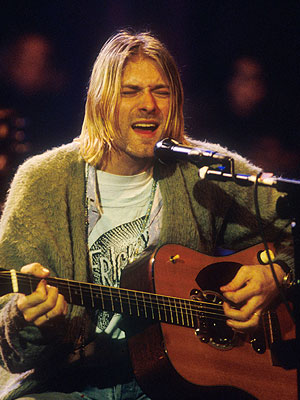
Nirvana embarked on a support tour and recorded and filmed an "unplugged" (acoustic) performance for MTV in November of 1993. Nirvana's choice to honour bands and people that had influenced them and Cobain's passionate and intense vocals especially on "Where Did You Sleep Last Night?"silenced many of their who had labeled Cobain talentless. Rumors circulated that the MTV Unplugged compilation would be Nirvana's last album and the band were splitting up.

Cobain was a gun fanatic and always had several in his possession or in various forms of confiscation. In the northern winter of 1993-94 Nirvana embarked on an extensive European tour. Twenty concerts into the tour Cobain developed throat problems and their schedule was interrupted while he recovered. While recovering Cobain flew to Rome to join his wife who was also preparing to tour with her own band. 


On March the 4th Cobain was rushed to hospital in a coma after an unsuccessful suicide bid in which he washed down about fifty prescription painkillers with champagne. The suicide bid was officially called an accident and was not even made known to close friends and associates. Several days later he returned to Seattle. Cobain's wife, friends and managers convinced Cobain, who was still in deep distress to enter a detox program in L.A. According to a missing person's report filed by his mother Cobain fled after only a few days of the program.

Cobain was cited in the Seattle area with a shotgun. Days later on the 5th of April he barricaded himself into the granny flat behind his mansion, put a shotgun in his mouth and pulled the trigger. On Thursday April the 7th ~ two days after a medical examiner says Cobain shot himself and the day before his body was found police say Courtney Love herself was taken to hospital in L.A. for a drug overdose. Released on bail, Love checked herself into a rehab center but left soon after a friend called her the next day with news of Cobain's death. 


Cobain's body was found when an electrician visiting the house to install a security system went round the back of the house when no one answered the front door and peered through windows. He thought he saw a mannequin sprawled on the floor until he noticed a splotch of blood by Cobain's ear. When police broke down the door they found Cobain dead on the floor, a shotgun still pointed at his chin and on a nearby counter a suicide note written in red ink addressed to Love and the couples then 19 month old daughter Frances Bean.


The suicide note ended with the words "I love you, I love you." Two days after Kurt Cobain's body was found about 5,000 people gathered in Seattle for a candlelight vigil. the distraught crowd filled the air with profane chants, burnt their flannel shirts and fought with police. They also listened to a tape made by Cobain's wife in which she read from his suicide note. Several distressed teenagers in the U.S. and Australia killed themselves. The mainstream media was lambasted for it's lack of respect and understanding of youth culture.


Tuesday, March 1, 2011

AMANDA PEET


Beauty is only temporary, but your mind lasts you a lifetime

Born on January 11th, 1972, Amanda Peet grew up in New York and made a decidedly unconventional debut into showbiz: At three-years-old, a thoroughly uninvited Peet jumped onto a stage during the middle of a play. Despite the auspicious beginning, Peet treated acting as more of a hobby than anything else, and only began to consider it a potential career after her drama professor at Columbia University encouraged her to audition for renowned acting teacher Uta_Hagen. Peet studied with Hagen for four years, during which time she participated in the off-Broadway revival +Awake and Sing. Though she would eventually be voted one of the year's 50 most beautiful people in a 2000 issue of People magazine -- not to mention participate with the likes of Susan_Sarandon, Samuel_L._Jackson, and Jack_Nicholson -- Peet worked as a waitress during the first few years of her acting career.


The sloe-eyed brunette made her onscreen debut in Craig_Singer'sAnimal_Room (1996). That same year, she could also be seen in an episode of Law & Order, and went on to play a role in Grind (1996), a crime drama starring Billy_Crudup. Before long, Peet landed a small role in theMichelle_Pfeiffer-George_Clooney romantic comedy One_Fine_Day. Since then, the actress has continued to build both her film and television credits: in 1997, she appeared in the AIDS drama Touch_Me, and the following year she had sizable roles in South Boston crime drama Southie with Donnie_Wahlberg and Rose McGowan, which won the American Independent award at the 1998 Seattle Film Festival. On television, she could be seen guest starring on a number of shows including Seinfeld and Ellen_Foster. In 1999, she got her own television show, Jack & Jill, on the WB network. That same year, she could be seen playing Sean_Patrick_Flanery's fiancée in Simply_Irresistible and then acting as his bedmate in Body_Shots, another in the long line of explorations into pre-millennial twentysomething dating angst.


After starring in director Neil_Turitz's debut Two_Ninas, Peet landed a leading role in Peter_M._Cohen's independent comedy Whipped. While the film itself performed dismally, Peet met her boyfriend, Brian_Van_Holt, on the set. Despite it's independent status, Whipped was given a solid amount of mainstream marketing, and Peet was praised for a game performance in the face of an admittedly weak script.


After a small role in 2000's Isn't_She_Great with Bette_Midler andNathan_Lane, Peet was finally recognized by critics and audiences alike inThe_Whole_Nine_Yards. Though the film itself did not fare particularly well, Peet was praised for holding her own against Hollywood heavy-hitterBruce_Willis, which certainly didn't hurt her when it came time to audition forSaving_Silverman, which placed her opposite Jason_Biggs while he was still reeling from the success of American_Pie. In 2002, Peet played a considerably less vicious wife in Changing_Lanes with Ben_Affleck and Samuel_L._Jackson, and won no small amount of praise for her performance as the heroin-addled mistress of Kieran_Culkin's godfather in Igby_Goes_Down. Peet would go on to star opposite film veterans Diane_Keaton and Jack_Nicholson inNancy_Meyers' Something's_Gotta_Give, in which she stars as Nicholson's scandalously young girlfriend, as well as James_Mangold's psychological thrillerIdentity with John_Cusack. In 2004, Peet signed on for the sequel toThe_Whole_Nine_Yards (aptly titled The_Whole_Ten_Yards), and acted alongside Will Ferrell, Chloë_Sevigny, and Josh_Brolin in the Woody_Allenfeature Melinda and Melinda. 

The next year, Peet starred alongside Ashton Kutcher in the romantic comedy A Lot Like Love, before joining the cast of the politically charged thriller Syriana. Then, in 2006, the actress accepted a recurring role on the one-hour drama Studio 60 On the Sunset Strip. The Aaron Sorkin written series received major critical acclaim but was cancelled after just one season. Undeterred, Peet next teamed up with John_Cusack for the quirky, heartfelt drama Martian Child. Rebecca Flint Marx, Rovi